
Jenny Saville’s “The Anatomy of Painting”, National Portrait Museum, London (20 June – 7 September 2025) is the largest major museum exhibition of her work to date
The picture above, shows the scale of Saville’s work with the viewer dwarfed by the giant canvas. The painting itself, 1999, “Hyphen” is a self-portrait with her sister; real women’s bodies, seen by real women depicted in thick sculptural paint. Whilst influenced by feminist art, she claims her work is primarily about human bodies. Hence the title of the show
Jenny Saville is no. 8 in my “2025: Top 10 Painters“. Although often compared to the British figurative painter, Lucien Freud, in my opinion her work is most similar in style to the American neo-expressionist Cecily Brown (no. 5 in my list – rankings being somewhat arbitrary), but British and understated
This post aims to show both the uniqueness of her work and how it builds of the giants of classical art from the Renaissance to contemporary including:
- Michelangelo
- Titian
- Rembrandt
- Picasso
- Bacon
- de Kooning
The compositions of classical masterpieces can be clearly seen in some of her work, whilst the energy is apparent in all of it
– right, 2019 Self-Portrait (After Rembrandt)

But to the exhibition, where I will look in detail at 5 of the 45 works on display, …
The first image setting the tone for the rest of the show:

“Propped”, 1992
Saville’s most famous early work which formed part of her graduation exhibition from the Glasgow School of Art from which it was acquired by Charles Saatchi. Thus immediately securing her position within the Young British Artists alongside Damien Hurst and Tracy Emin
In 2018, the painting sold at Sotheby’s London for $12.4m, breaking the record at the time for a living female artist
[see my post “Female British Artist“]
Propped is a huge 6 foot by 7 foot canvas that was originally displayed opposite a mirror. In this way it looks as though the words are written on the mirror, in which the viewer can see both the painting (of a naked woman from an unflattering angle) and themselves. The text is a quote from Luce Irigaray’s 1977 essay, When Our Lips Speak Together:
If we continue to speak in this sameness — speak as men have spoken for centuries, we will fail each other. Again. Words will pass through our bodies, above our heads — disappear, make us disappear.”
This quote was adopted by Saville as a personal slogan and mantra
“Stare”, 2005
Used as the cover for the Manic Street Preachers’, 2009 album “Journal for Plague Lovers” where it was generally interpreted as showing a boy with blood on his face from having been beaten. Consequently, four of the UK’s top supermarkets deemed it to be inappropriate and sold the album in a plain slipcase
In the exhibition it is claimed that the inspiration for the painting was a small photograph in a medical textbook of a young woman with a port-wine birthmark on her face
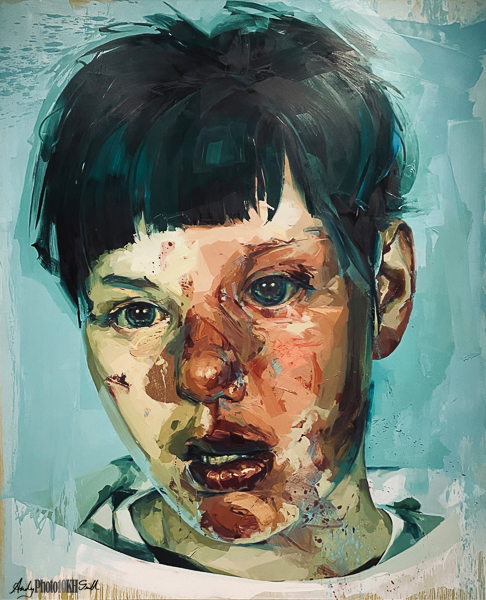
Despite my suggestion at the start of this post that Saville is an “understated neo-expressionist”, which is a largely male dominated genre, Stare is by no means understated and shows both physical and psychological violence, and gender ambiguity. The original work displayed is almost tactile as layers of paint display both strengths and vulnerabilities of the sitter

“The Mothers”, 2011
A gentle self-portrait with children, draws upon Leonardo da Vinci’s The Virgin and Child with Saint Anne and Saint John the Baptist with which Saville has been familiar since a child, as her parents had a reproduction in their home
Rather than the idealised depiction of the infant Jesus, The Mothers shows a relatable version of motherhood, born of Saville’s personal experience
“Rosetta II”, 2006
This is the stare of a blind person. It is influenced by Picasso’s 1903 portrait of La Celestina, from his blue periods, which in turn was influence by the figures of El Greco


In 2019 Saville met Sergio Risaliti, the director of the Museo Novecento, Florence, and was invited to be part of a city-wide installation project that would embed her contemporary work in direct conversation with Renaissance sites and artworks. This led to 2 years of intensive work and the creation of her Pietà l, below, and it being installed next to Michelangelo’s The Deposition inside the Museo del Duomo
 |  |
| “Pietà l”, 2021 Jenny Saville | “The Deposition”, 1547 Michelangelo |
The title, Pietà, is a reference to Christian art, meaning pity, in which the mortal body of Christ is held by the Virgin Mary either alone or surrounded by celestial figures. Saville’s response is a contemporary perspective on the themes of grief, suffering and humanity
As the title suggests, Pietà l, is the first of a series of at least 4 works
The above is a discussion of just 5 of the paintings on display which I hope shows my enthusiasm for Saville as one of the most significant living artists
The exhibition itself has been well staged with good lighting and in most cases no barrier between the viewer and the work, which means you can appreciate the sculptural way in which she manipulates the paint. Which brings to mind the quote:
Flesh is the reason oil paint was invented.”
Willem de Kooning, 1950
45 paintings means you can see everything in about an hour, and leave wanting more without feeling either short changed or overwhelmed
I will return. In fact I might even take out membership of the NPG purely so that I can do so repeatedly. (I attended the “Capturing the Moment” exhibition at the Tate Modern at least 5 times)